
A Simple Guide to Customs Duty on Personal Imports and Overseas Online Shopping (with Examples)

Here we explain the customs duty charged when you import products yourself through overseas online shopping.
When you buy products from overseas, you are charged customs duty as well as consumption tax.
Customs duty is complicated because the amount differs depending on the type of product, its price and other factors.
We explain this confusing topic in plain terms, with concrete examples.
If you want to know about the customs duty charged on overseas online shopping, please use this as a reference.
Taxes charged on overseas online shopping (consumption tax and customs duty)
When you import products yourself, you are charged consumption tax and customs duty.
Consumption tax is charged at a rate of 10% in principle, the same as what you pay when shopping in Japan.
When you import products through overseas online shopping and similar channels, you are charged customs duty, a tax on imported goods, in addition to consumption tax.
Consumption tax
When you buy a product, consumption tax is charged on top of the price.
This consumption tax applies when you import products from overseas, just as it does when you shop in Japan.
The standard rate of consumption tax is 10%, so on a 1,000 yen item you pay 100 yen (food and some other items have a reduced rate).
The tax you pay along with the price is passed on to the tax office through the shop.
This is how we pay consumption tax to the government through everyday shopping, dining out and so on.
The same consumption tax applies, and you pay it, when you import products from overseas.
Customs duty
Customs duty is a tax charged when you import products from overseas, and it is also charged when you buy products from overseas online shops.
Duty differs by the type of product you buy, such as food or clothing, and the amount also changes with the product price and other factors, so it is complicated.
Here we explain customs duty in plain terms, including what it is and how the amount is decided.
Why there is customs duty on personal imports and overseas online shopping
Customs duty exists to protect domestic products from cheap foreign products.
If cheap foreign products, such as cheap foreign food or cheap car parts, were sold in Japan at their low prices, consumers would stop buying expensive domestic products.
Then products from Japanese companies would stop selling, Japanese companies would go under one after another, and Japanese jobs would be lost.
To prevent this, taxes are placed on products imported from abroad to make them more expensive.
In this way, customs duty exists to protect Japanese industry.
How customs duty is decided
There are rules for customs duty, and the amount is decided according to them.
The amount of duty is decided by the type of product, the country you import from, and the purpose of use.
Type of product
The duty rate changes depending on what product you import.
Products are classified in detail by type, such as food and clothing, and even for clothing alone, the rate changes by material and weave.
For example, for wool clothing, the classification depends on factors such as what share of the total weight is wool.
Related article: About US weights and units (in Japanese)
Country you import from
Even for the same product, the duty rate changes depending on the country you import from.
Between countries that have signed agreements to liberalize or ease trade, such as a “Free Trade Agreement (FTA),” an “Economic Partnership Agreement (EPA)” or the “Trans-Pacific Partnership (TPP),” no duty may be charged.
For example, even for a product with a high basic duty rate, if it was made in a country with an agreement, the duty may be lower or may not apply.
Purpose of use
The rate also changes depending on the purpose for which you use the imported product.
When you import for sale, the normal duty applies, but when you import for personal use, there is a special rule under which the dutiable value is calculated as 60% of the overseas retail price, so you pay less duty than usual.
However, this “x0.6” special rule is scheduled to be abolished on April 1, 2028.
How to calculate customs duty
For products for personal use, customs duty is calculated as follows (until March 2028).
Dutiable value = product price x 60%
Duty = dutiable value x duty rate
For example, if you import a product priced at 20,000 yen and the duty rate is 6.4%:
Dutiable value = 20,000 yen x 0.6 (60%) = 12,000 yen
Duty = 12,000 yen x 0.064 (6.4%) = 768 yen
So the duty is 768 yen. The actual duty rate differs by product.
Duty exemption
The exemption is a rule under which products of 10,000 yen or less are exempt.
Under the exemption, if the total dutiable value is 10,000 yen or less, it is exempt, so no customs duty or consumption tax is charged.
For products for personal use, the dutiable value is 60% of the product price, so if the price of the product you import from overseas is about 16,666 yen or less, it is likely to be exempt.
There are three things to note here.
The first is that the exemption applies to the “total” of the amount you bought. It is not about a single product; the total value of the products consolidated in one shipment must be 16,666 yen or less.
The second is that some products are excluded from the exemption.
Products excluded from the exemption, such as alcohol, tobacco, footwear, knitted goods and some leather goods, are not exempt even at 16,666 yen or less.
The third is that the rules are scheduled to change. On April 1, 2028, the “x0.6” special rule is scheduled to be abolished, and consumption tax is scheduled to apply to online orders of 10,000 yen or less as well. Taxes will then also be charged on products of roughly 10,000 to 16,666 yen that were previously exempt. For details, see the page on customs duty.
Simplified rates for shipments totaling 200,000 yen or less
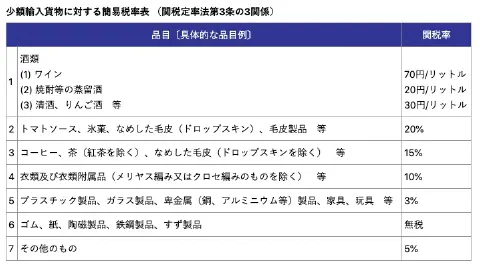
Simplified rates apply when the dutiable value is 200,000 yen or less, and the rates are set simply, as shown in the table below.
For personal imports, the total value of the products is mostly 200,000 yen or less, so you should basically apply these simplified rates.
Simplified rate table (this is an earlier guide; check the Customs website for the latest rates)
https://www.customs.go.jp/tsukan/kanizeiritsu.htm
Some products are excluded from the simplified rates. The products in the list below are subject to the general rates, not the simplified rates, even at 200,000 yen or less.
Products subject to the general rates
- Grains such as rice, and their preparations
- Milk, cream and similar, and their preparations
- Prepared meat products such as ham and canned beef
- Tobacco and refined salt
- Leather goods such as travel goods and handbags
- Knitted clothing
- Footwear
- Imitation jewelry for personal adornment (excluding those made of base metal)
General rates for amounts over 200,000 yen
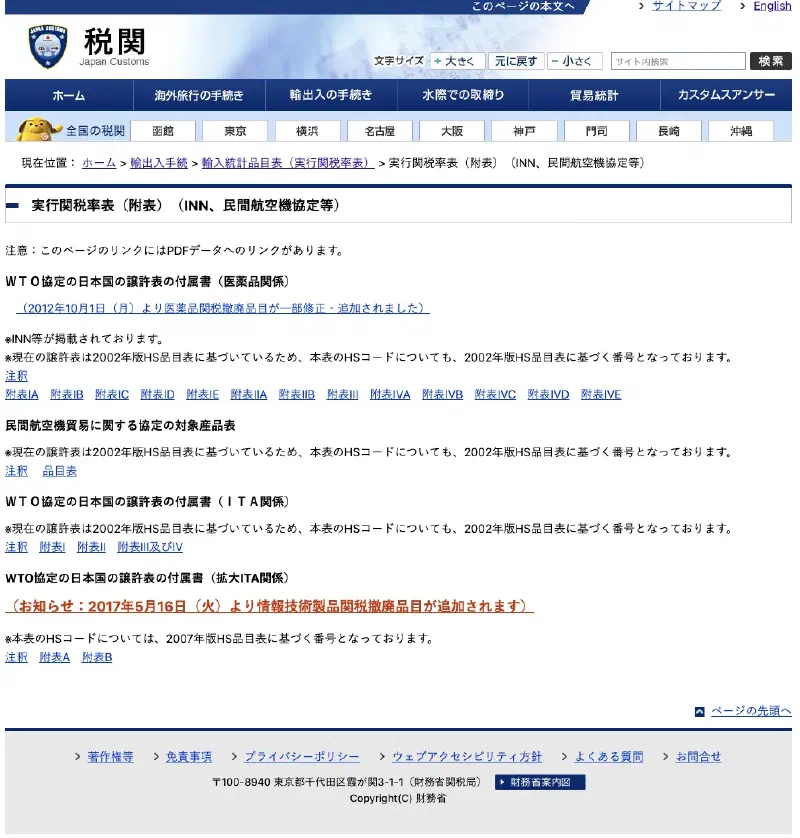
When the total dutiable value exceeds 200,000 yen, or for products to which the simplified rates do not apply, the general rates apply, as shown in the table below.
https://www.customs.go.jp/tariff/fuhyo/index.htm
As explained above, the general rates are divided in great detail and change a lot depending on the type of product, the country you import from, the purpose of use and so on.
The duty rates in this table are also not necessarily applied as they are, so please use them only as a guide.
Another option is a handy service called “Web Tariff” (in Japanese).
Who do you pay customs duty to?
You pay customs duty to Japan Customs.
You do not pay it to the overseas shop or to overseas customs; you pay it to Japan Customs. In practice, it is common for the delivery company to pay it on your behalf and for you to pay the delivery driver when you receive the package.
How to pay customs duty
Here is how you pay customs duty.
When you import for personal use from an overseas shop, the package is shipped internationally, and you pay the duty when you receive it from the delivery driver at your front door.
By paying the delivery driver when you receive the package, the duty is paid to Japan Customs. Depending on the delivery company, an advance-payment handling fee may be charged.
At Planet Express, if you choose a shipping method that includes customs duty and consumption tax, such as FedEx DDP or DDP Air, you can prepay them at the time of shipping. There is nothing to pay on delivery.
The payment method above is for when you import for personal use from an overseas shop.
How customs duty is paid differs depending on whether you are importing for personal use from an overseas shop or importing for commercial purposes.
How you come to be charged customs duty
Here is how you come to be charged customs duty, first when you import through Japan Post and then when you import through a private delivery company.
The way customs duty is paid is the same in both cases.
When importing through Japan Post
- A customs officer checks the import documents
- A customs officer decides the duty charged on each product
- Japan Post pays the duty on your behalf
- You pay the duty through the delivery person
When importing through a private delivery company
- The private delivery company files a declaration with customs on your behalf
- The private delivery company pays the duty on your behalf
- You pay the duty through the delivery person
So whether it is Japan Post or a private company, they pay the duty at customs on your behalf, and you pay back the duty they covered when you receive the product.
Examples of customs duty on overseas online shopping and personal imports
Here are two concrete examples of the customs duty charged when you import products from overseas.
As introduced above, the formulas for customs duty are as follows.
Dutiable value = product price x 60%
Duty = dutiable value x duty rate
Now let us look at the two examples.
Duty on personally importing children’s clothes worth 11,000 yen
If the total dutiable value is 10,000 yen or less, it is exempt, and products up to a price of 16,666 yen are eligible for the exemption.
If you import children’s clothes worth 11,000 yen, no duty is charged.
Duty on personally importing a jacket worth 80,000 yen
A jacket worth 80,000 yen exceeds the product price of 16,666 yen, so duty is charged.
Also, the dutiable value is 200,000 yen or less, so the simplified rates apply. Here we calculate with a clothing rate of 10%.
If you import a jacket worth 80,000 yen:
Dutiable value = 80,000 x 0.6 (60%) = 48,000 yen
Assuming a clothing rate of 10%:
Duty = 48,000 x 0.1 (10%) = 4,800 yen
So the duty charged on a jacket worth 80,000 yen is 4,800 yen. Consumption tax is charged in addition.
Note that after the “x0.6” special rule is abolished on April 1, 2028, the product price is scheduled to become the dutiable value as it is.
Customs duty on personal imports: frequently asked questions
Here are frequently asked questions about customs duty on personal imports, with answers in Q&A form.
Q. What taxes, including customs duty, are charged when I import something myself?
A. Besides customs duty, the import taxes charged on personal imports include consumption tax and liquor tax.
- Customs duty: a tax charged on goods imported from abroad to protect Japanese industry.
- Consumption tax: the same as the tax charged when you buy products at a supermarket or other shop in Japan, and it is also charged when you buy products from overseas.
- Domestic excise taxes: taxes charged on specific products, such as liquor tax and tobacco tax.
Q. Is customs duty always charged?
A. If the dutiable value (for personal use, product price x 0.6) is 10,000 yen or less, neither customs duty nor consumption tax is charged in principle.
However, some products are exceptions, and products like these are exceptions.
Exception products: alcohol, tobacco, leather bags, leather gloves, knitted clothing (T-shirts, sweaters and so on), footwear, leather shoes and so on
If the dutiable value exceeds 10,000 yen and is 200,000 yen or less, customs duty and consumption tax are charged.
If the duty rate is 0%, only consumption tax is charged.
Q. How does the duty amount differ by product?
A. Customs duty differs greatly depending on a product’s material, whether it has been processed, its use, its country of origin and so on.
Each product is classified into very detailed categories.
For example, T-shirts are classified by the items below, and the rate differs depending on what kind of T-shirt it is.
- Country of origin
- Material
- Weaving method
- Single color or multicolor
- Whether it has decoration such as embroidery or lace
Leather shoes are one of the products with high customs duty in Japan, so check the rate before you import.
For the duty rates on main products imported for personal use, see the Customs website.
Which category a product belongs to may need to be decided by looking at the actual product at customs.
Q. How is customs duty calculated?
A. Here is how customs duty is calculated when you import for personal use from an overseas shop.
When the dutiable value exceeds 10,000 yen and is 200,000 yen or less, the calculation is as follows.
Calculation: duty = dutiable value x duty rate
Example: you buy a product for 250 dollars (about 38,750 yen) and the duty rate is 10%
Duty = (250 x 0.6) x 10% = 15 dollars (about 2,325 yen)
(Calculated at 1 dollar = about 155 yen)
Q. Is the duty amount fixed?
A. Even for the same product, the amount of duty and consumption tax can change depending on that day’s exchange rate.
Even for the same product at the same price, the duty and consumption tax are not necessarily the same.
If you do not know the taxes on the imported goods at the time of import, you may end up with “a much higher amount than I expected.”
When you import products from overseas into Japan, we recommend looking up the duty charged each time and calculating it before you buy.
What happens to customs duty when you use a proxy company?
Here is how customs duty works when you use a personal import proxy company.
For ordinary personal imports, we explained that you pay the delivery driver the duty when you receive the product.
When you use a proxy company, how duty is paid is slightly different from ordinary personal imports.
When you ask a proxy company to buy and ship products, there are two patterns, and how duty is paid differs by pattern.
Pattern where the shop ships directly
When the proxy company orders a product from an overseas shop on your behalf and sets the delivery address to “the client,” the product is shipped directly from overseas to the client.
In this case, the client who asked the proxy company is the importer.
For ordinary imports, you pay customs duty and consumption tax to the delivery driver when the product arrives at your home.
Pattern where the product is shipped via the proxy company
When the proxy company orders a product from an overseas shop and sets the delivery address to “the proxy company,” the product goes from the overseas shop to the proxy company to the client.
In this case, the proxy company is the importer.
When the proxy company is the importer, it first pays customs duty and consumption tax on your behalf.
Afterward, the proxy company bills the client for domestic shipping, customs duty and consumption tax.
When the client pays this total and the proxy company confirms the payment, the product is shipped to the client.
So in this case, you do not need to pay the delivery driver customs duty or consumption tax when the product arrives at your home.
That is because you have already paid the proxy company the duty and consumption tax together with the domestic shipping fee.
Summary
Here we explained the customs duty charged when you import products yourself through overseas online shopping.
The amount of duty differs by the type of product, the country, the purpose and so on.
It also changes depending on the total value of your products, through the exemption and the simplified rates.
Customs duty may seem difficult, but if you check the rules and the calculation method, you can work out how much it will be.
When you do overseas online shopping with good value, please use what we introduced here as a reference to check how much duty will be charged.